
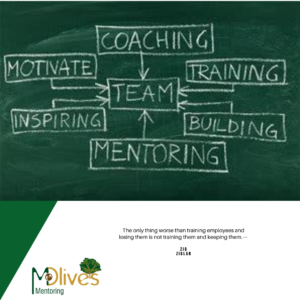
 If you stepped down from your leadership role, would you leave with confidence that your team would adjust seamlessly and that the business will continue to thrive? This is what is possible if you coach or mentor to develop your team. It is absolutely worth your time. However, to effectively coach or mentor your team you must shift your thinking.
“The only thing worse than training employees and losing them is not training them and keeping them”-Zig Ziglar
Shift your thinking; Have you found yourself saying about yourself or others; “This person just doesn’t get it” or “This person will never have what it takes”? If so you may have what Stanford psychologist Carol Dweck calls a fixed mind-set, which will severally limit your ability to make a difference as a mentor or a coach. Low expectations rarely yield growth and often lead to frustration on both sides. You may occasionally encounter someone who truly can’t develop, but the real barrier is most often the belief that the person won’t make progress.
“..when people already know they’re deficient, they have nothing to lose by training” Carol S..Dweck
Shifting your mindset; As a leader it is less time consuming to embrace a growth mindset-one that assumes your team can learn. If you invest in their mentoring, coaching and development early on, you will reap the benefits later. They will start solving more of their day to day problems, freeing you to focus on strategic issues and developing more leaders.
“Progress is impossible without change; and those who cannot change their minds cannot change anything.” George Benard Shaw
Sharpening your skills-active listening; Before you can help others to grow you need to hone a few skills and one such skill is active listening. You are likely to miss out on critical information if you find yourself; Talking more than listening, suggesting solutions before the person has the chance to do so, interrupting, thinking about what you want to say next instead of focusing on what the person is saying, using body language that signals impatience or distraction-checking your email, accepting phone calls, leaning back on your chair etc or saying what you would have done differently in the same situation.
Listening is often the only thing needed to help someone-unknown read
Sharpening your skills-recognizing your biases. As a mentor or a coach your own preferences can get in the way of helping other. May be you have a gut reaction against certain personality types or struggle to identify with people whose thinking or work styles differ with yours. Whatever your biases recognizing them allows you to make effort to overcome or lessen their influence. One way to overcome your biases is striving to know yourself-dig deeper into your drivers, values and beliefs. This way you increase your capacity for self-reflection an are able to adjust your behavior to effectively help others.
I suppose it is tempting, if the only tool you have is a hammer, to treat everything as if it were a nail. Abraham Maslow,[/vc_column_text][/vc_column][/vc_row][vc_row][vc_column width=”1/2″][vc_single_image image=”998″ label=””][vc_column_text]Mary Kamore is the Lead Consultant Molives Mentors[/vc_column_text][/vc_column][vc_column width=”1/2″][/vc_column][/vc_row]