
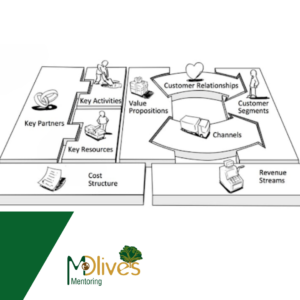
What and Why a Business Model Canvas?
A ‘Business model’ is a description of how your business makes money-it describes how a Business creates, delivers and captures value.
A Business Model Canvas is a great way of mapping out an idea, allowing it to be understood, tested and improved. The tool is a single page with nine connected boxes, which show how all parts of your business work together for success. It can be sketched anywhere – on a whiteboard or notepad. A Business Model Canvas can be used when starting a new Business or when updating an existing Business idea
When filling out a Business Model Canvas, it is important to brainstorm and conduct research on each of the nine elements. This week we discussed four of the elements.
- Customer Segments
In this building block, you enter the different customer segments that you will serve. These are the groups of people or companies that you are trying to target and sell your product or service to.
Segmenting your customers based on similarities such as geographical area, gender, age, behaviors, interests, etc. gives you the opportunity to better serve their needs, specifically by customizing the solution you are providing them. One really important point to get across here is that customers don’t exist for you, but rather you exist to serve your customers.
Question; Which customers and users are you serving? Which jobs do they really want to get done?
2. Value propositions
At the center of your Canvas is the Value Proposition box. Inside this very important box you write down your unique solution (product or service) for a problem faced by a customer (that which creates value for the customer segment). A value proposition should be unique or should be different from that of your competitors.
Think about a ‘Unique Value Proposition’ (UVP)-why are you different and worth getting attention? What are you offering them? Some common value propositions are include; High performance, Ability to customize, Design, Price, Convenience etc.
Good news! You don’t have to get this perfect right away. Like everything on the Canvas, start with a best guess and perfect as you go.
- Channels
In this block you describe how your company will communicate with and reach out to your customers. How does each customer want to be reached? How are your products and services delivered to the market?
Channels are the touchpoints that let your customers connect with your company. They play two main roles; (i) raising awareness of your product or service among customers and (ii) delivering your value propositions to them. There are two types of channels
- Owned channels: This includes your company/business website, social media sites, in-house sales, etc.
- Partner channels: These are partner-owned websites, wholesale distribution, retail etc
4. Customer Relationships
In this section, you write down the type of relationship you will have with each of your customer segments. How will you interact with them throughout their journey with your business? It is here that you answer the question of how you get, keep, and grow customers;
- Get: Establish how customers find out about you to make their initial purchase e.g. advertising on Google/facebook, referral etc.
- Keep: How do you keep customers? e.g. excellent customer service.
- Grow: How do you get your customers to spend more? e.g sending out a monthly update/newsletter to keep them informed about your latest products or service.
The easiest way to define all of this is to walk through the entire customer journey in detail- a customer journey map. Know how customers find out about you, investigate whether to buy your product, purchase it and how they are managed after purchase. This will help you make sense of how to get, keep and grow your customers.[/vc_column_text][/vc_column][/vc_row][vc_row][vc_column width=”1/2″][vc_single_image image=”835″][vc_column_text]Mary Kamore is the Lead Consultant M_OliveS Mentors[/vc_column_text][vc_column_text][/vc_column_text][/vc_column][vc_column width=”1/2″][/vc_column][/vc_row][vc_row][vc_column][/vc_column][/vc_row]