
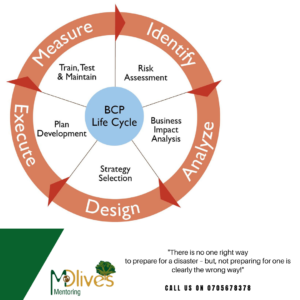
 You possibly know about Business Continuity Planning (BCP) and that it helps a business continue operating in the event of major disasters e.g. fires. However, and possibly like me, less did you know that a disaster can get this close and hit this hard leaving your Businesses on its knees-that is what COVID-19 has done. It is, therefore, now time to not only think about BCP but to get it done as soon as possible.
And so we get to ask ourselves; What is Business Continuity Planning (BCP)? Why do you need it? And how do you do it?
What is Business Continuity Planning (BCP)? ; It is the process a company undergoes to create prevention and a recovery system from potential threats such as natural disasters (fire, floods) or cyber-attacks, relevant example being the current COVID-19 crisis.
Longevity in business is about being able to reinvent yourself: Satya Nadella
Why Business Continuity Planning (BCP)? ; Becoming an entrepreneur is all about taking risks. In order to ensure that your business is sustainable, you need to put in place systems that can prevent threats whether internal or external that may try to interfere with your day to day operations. BCP ensures that personnel and assets are protected and are able to function quickly in the event of a disaster. Some benefits of BCP include;
- It enables your business to be well prepared for a disaster
- It gives your business more flexibility so that it can adapt to changes in future
- It stops the staff from panicking in case the business is faced with a threat
- It helps to minimize losses
During the COVID-19 crisis BCP will help you to; 1) Establish the risk profile of your business and the level of vulnerability to COVID-19 in terms of its impact on your People, Processes, Profits and Partnerships (the “4Ps”).
- People: lives of workers and family members
- Processes: enterprise operations
- Profits: revenue generation
- Partnerships: enabling environment to carry out business operations
and 2) Develop an effective risk and emergency arrangement for the business.
“It takes years to build a Business but only minutes to lose it” Warren Buffet
How do you write a Business Continuity Plan during this COVID-19 crisis? BCP is generally conceived in advance and involves input from key stakeholders and personnel. It is important to consider using a Business Continuity Planning (BCP) tool. Let us look at a tool that is mostly targeted at smaller enterprises with limited resources and structured in two parts.
- The first part of the tool is risk assessment that you can quickly do. It establishes the level of risk/vulnerability to your enterprises.
- The second part of the tool is six-step processes to assist you develop your own Business Continuity Plan.
Part 1: Establish your risk profile (Self-assessment); Here you need to ask yourself questions around the 4P’s; ‘People, Processes, Profits and Partnerships’. You will then need to estimate your vulnerability level by use of a Risk Matrix which will help you do a comprehensive assessment and hence identify which of the 4P’s (people, processes, profits and partnerships) your business is most vulnerable to (and which aspects in particular).
Part 2: Develop a six-step COVID-19 BCP; The following are the six steps needed to establish your business continuity plan (BCP):
Step 1: Identify your key products/services. What are your most important products/services? Consider the following criteria:
- Share of income they generate
- Amount of clients demanding them; and
- Cost of non-delivery (what happens if you don’t deliver): negative financial, productivity and reputational consequences.
Step 2: Establish the objective of your BCP. What do you want to achieve by establishing your BCP?
Consider the following; What departments will the plan cover? What are the outcomes of a successful plan? Which milestones should we track?
Step 3: Evaluate the potential impact of disruptions to your business and workers/staff. How long can interruptions last before becoming intolerable? What are the resources required and who are the suppliers/partners/ contractors needed to conduct key operations?
Step 4: List action to protect your business by using the 4Ps framework. Consider actions to minimize risk to your: People(lives of workers and family members), Processes(enterprise operations), Profits(revenue generation) and Partnerships(enabling environment to carry out business operations).
Step 5: Establish contact lists. Note that most of your activities will be non-physical (Mobile phone calls, texts, WhatsApp calls, zoom meetings, Googlemeet etc). Make sure you have accurate and updated lists of all your key stakeholders (suppliers/partners/ contractors).
Step 6: Maintain, review and continuously update your BCP; Once you have a business continuity plan in place, don’t forget to update and adapt it regularly. A BCP that is not constantly tested and updated will be of little help. Changes have to be monitored; impacts, risk and continuity strategies need to be reevaluated.
“The only thing harder than planning for a disaster is explaining why you didn’t”
“You never want a serious crisis to go to waste” Obama Chief of staff
[/vc_column_text][/vc_column][/vc_row][vc_row][vc_column width=”1/2″][vc_single_image image=”620″ label=””][vc_column_text]Mary Kamore is the Lead Consultant MoliveS Mentors[/vc_column_text][/vc_column][/vc_row]
BCP has previously been viewed as a theoretical concept in ICT related discussions. However Covid-19 has made it to be a must do just like going digital.
The Covid 19 has the hospitality industry very hard,what’s more the conditions for back to business are even tougher,thank you very the Continuity plan shall study it very keenly.