FINANCING YOUR BUSINESS


FINANCING YOUR BUSINESS

Business financing is raising the necessary capital to start or expand a business. Building a business requires capital-whether it is your own or other people’s money, you will need capital. Without access to capital, great ideas die and great profitable businesses go bankrupt. The entrepreneur’s ability to access financing is key to his or her success. It is not possible for every entrepreneur to self-finance and even if you start with self-financing, growth sometimes makes it difficult to continue doing so comfortably. Here are some things to consider when it comes to financing your business;

Seek advice; You do not have to be an expert in business financing but you can consider talking to a mentor, a business coach or a consultant. This should be someone with expertise in business financing who can guide you on the best form of financing for you.

Have a written business plan; Though it is not impossible to raise money without a business plan, a written plan allows for investors and lenders to confirm that you have a viable business with a clear business strategy. It is therefore important to have a written business plan.

Keep expenses to a minimum; Remember that self-financing is the best and keeping your expenses to a minimum makes it easier for you to self-finance. And even when you need external capital, it keeps the capital you need to a minimum.

Use your own savings and assets; What do you have in your hand? Don’t be quick to seek external capital, first use what you have. Furthermore, your ability to demonstrate that you have invested your own money is key to getting the trust of investors and lenders.

Leverage your personal network; Consider who you know and the relationships you have that can help tap into financing. The key to success is not just what you know, but who you know.

Reflection

Ask, and it will be given unto you; seek and you will find; knock, and it will be opened for you. For everyone who asks receives, and he who seeks finds, and to him who knocks it will be opened. -Mathew 7:7-8

Mary Kamore is the Lead Consultant M_OliveS Mentors

Share this cohort:
blog-banner

UNDERSTANDING YOUR BUSINESS IDEA

What is a business idea?

A business idea is a thought that exist in the mind that can be developed into a product or service. Ideas are best born from an internal passion to address a clear market problem or make a difference in a particular area of the community or world. Every entrepreneur is in pursuit of the ideal business idea. Having a clear idea is essential to developing a viable business plan and building a profitable business.

How do you originate a business idea?

  • Ideas are born out of passion
  • Ideas are generated by market needs
  • Ideas are developed through knowledge

The characteristics of a good idea;

  • It defines the type of business
  • It defines the products or services you will be providing
  • It defines your target market
  • It defines the need you are meeting
  • It States the gift, skill and experience necessary to carry out the idea
  • It defines the value proposition

As you prepare your business idea, you should clarify it by assessing the following

  • Your motivation: What is motivating you to start the business? Your motivation is what inspires you to establish the business.
  • Your Purpose; What is the reason for your existence? Why did God place you on earth?
  • Your gifts, skills, and abilities; Do your gifts, skills, abilities, Knowledge or experience match your business idea?
  • Assess Market need; A need is a lack or a problem that requires a business solution. Have you identified one?
  • Identify your Products and services; What solution do you propose for the need you have identified?
  • Clarify the value proposition; What value does your business bring to the community and to the consumer of the product or service?

Reflection

If any of you lacks wisdom, let him ask God, who gives it liberally and without reproach, and it will be given to him. –James 1:5

Mary Kamore is the Lead Consultant M_OliveS Mentors

Share this cohort:
Peer-Mentoring

BUILDING YOUR BUSINESS RESILIENCE IN COVID TIMES AND BEYOND

[vc_row][vc_column][vc_column_text]The key goal in managing forceful and unpredictable challenges is resilience– the ability to survive and thrive through erratic, changing, and potentially hostile events.

Five ways in which you can build your Business Resilience

  1. Taking action and moving forward

A crisis like the one we’re currently experiencing requires quick thinking in the face of uncertainty. However as an entrepreneur you may find yourself dealing with “analysis paralysis,”- inability to make a decision due to overthinking.

Delaying decisions will only lead to more problems—and those problems will require more decisions. “In the military, it doesn’t matter in which direction you choose to move when under a mortar attack, just so long as you move. Decisions are never final for the simple fact that change is never absolute.” Jeff Boss

Some actions that are resilient in nature include;

  • Diversify: Having multiple approaches to doing Business can be less efficient but hardy in crisis situations.
  • Evolvability: Constant improvement in the light of new opportunities, problems, or information. Align your business systems and processes to accommodate adjustments during this period. g online selling (e-commerce, virtual marketing, use of social media platforms etc.), virtual offices
  • Embeddedness: Businesses are stakeholders in the wider systems-economically and socially. Support to all stakeholders in a time of adversity can potentially create lasting goodwill and trust.

What to do: Break down what you need to do into smaller steps and then attend to issues based on their level of urgency. “How do you eat an elephant? One bite at a time”

  1. Dealing with information overload

While having access to the latest news is undoubtedly a blessing, it can also be a burden. Information overload is a very real thing that occurs when there is too much relevant information being disseminated at the same time.

When there’s an information surplus, we tend to miss out on important news or even succumb to potentially harmful misinformation. In fact, research shows that false news travels faster than true stories on social media.

What to do; In order to make sense of all the conflicting information out there, evaluate whether the information you are reading is fact-checked and from a reliable source. It’s also good to set a limit for yourself. Continuously exposing yourself to upsetting news will only heighten anxiety.

  1. Selecting the right focus

As a Business owner it can be difficult to know where to prioritize time and resources. One way to choose is to consider what is truly important to your business. For most of us, that’s people—employees, customers, vendors, partners.

What to do; Your first priority should be the safety and well-being of your employees. Up next would be communicating with customers. They may not be in a position to patronize your business, but they still want to be updated on any changes to its operations. The same goes for other stakeholders so they know what your status is and what to expect moving forward. Other areas of focus include; Cash flow and Insurance, Business Continuity, tax and audit.

4.       Keeping your eyes on other risks

COVID-19 isn’t the only threat on the horizon — and often you are most vulnerable when dealing with a crisis that dominates your attention. The many other risks that your business faces aren’t diminished by an epidemic. Cybersecurity, for example, should always be top of mind. Others include; Financial risks, Reputation risk, Operational risks, competition risks etc

  1. Finding balance and achieving a healthy mindset

We’re all experiencing a lot of intense emotions during these ever-evolving times, and as an entrepreneur/Business owner you have an additional level of stress as you try to do what is best for you employees and customers.

Remember “you can’t pour from an empty cup.” Overextending yourself leads to burnout, and once you reach that state you won’t be able to help anyone. That’s why it’s imperative that you carve out time to recharge and take care of yourself.

What to do; Be intentional by setting a block of time in your schedule for self-care—whether that be going for a walk, spending time with your family, or enjoying a long’ hot bath’. The more you’re able to find inner calm during this crisis, the better able you are to make decisions and lead your business.

Conclusion

The scale of this crisis is unprecedented, but there is a silver lining. Eventually, you will come out on the other side of this pandemic with a greater sense of personal empowerment, growth and increased connection to your community (customers, employees, stakeholders)—all of which will be advantages for your businesses now and in the future.

Psalm 46

God is our refuge and strength,
an ever-present help in trouble.
Therefore we will not fear, though the earth gives way
and the mountains fall into the heart of the sea,

https://drive.google.com/file/d/1wNCkMZ8KxqRYiVJVnzI3fQdEUUsqxYto/view?usp=drivesdk[/vc_column_text][/vc_column][/vc_row][vc_row][vc_column width=”1/2″][vc_single_image image=”998″ label=””][vc_column_text]Mary Kamore is the Lead Consultant Molives Mentors[/vc_column_text][/vc_column][/vc_row]

Share this cohort:

DEVELOPING YOUR TEAM

[vc_row][vc_column][vc_column_text]If you stepped down from your leadership role, would you leave with confidence that your team would adjust seamlessly and that the business will continue to thrive?  This is what is possible if you coach or mentor to develop your team. It is absolutely worth your time. However, to effectively coach or mentor your team you must shift your thinking. Continue Reading

Share this cohort:

Our youth, our gift

[vc_row][vc_column][vc_column_text]Africa is demographically the world’s youngest continent. By 2030, about 20% of the global labour force and nearly 35% of the global youth labour force will be from this region. While 10 to 12 million Africa’s youth enter the workforce each year, only 3 million formal jobs are created. Indeed, the impact of the ongoing COVID-19 pandemic will likely worsen this trend. With most African countries in lockdown, the impact of COVID-19 on economies and businesses will be significant and long-lasting. According to a recent assessment by the ILO, almost 25 million jobs could be lost worldwide as a result of the pandemic. Both the formal and informal sectors are threatened with destruction. Noting that 15-34 year-olds make up close to half of the continent’s working age population; young people will be the first to feel the effects of this recession – and most likely the last to recover. This is a sad reality on a continent with such an impressive pool of youth, talent and creativity. Lack of youth employment opportunities undermines Economic growth, Social cohesion and Political stability.

From the demand-side perspective, COVID-19 has reduced consumption, and neither African SMEs nor their countries have sufficient market infrastructure (such as internet connectivity or e-commerce markets) to help mitigate this shock. From the supply-side, the virus has affected workers in terms of employment and access to work, and mitigation measures have caused a slowdown of economic activity. The sectors that are most at risk of COVID-19 disruptions in Africa are: wholesale and retail trade, manufacturing, administrative services, and hospitality (including tourism). Along with agriculture, these sectors represent many of the key industries where young people currently find employment.

In the midst of this gloomy scenario what opportunities may be opening up for the youth? Where would a youth start in a depressed Economy?

The truth is that this crisis comes with opportunities. The old Chinese proverb; ‘A crisis is an opportunity riding the dangerous wind’ applies even now. If you look around, you will realize there are more opportunities than threats. As long as the world has not come to an end yet, there will always be needs; people must eat, have a roof over their heads, keep warm & healthy etc. Allow the crisis to ignite the creativity in you; quarantine, lock-down and all other mitigation measures although painful gives a rare time for planning, reflection and self-examination. There will definitely be winners and losers during and after this pandemic; how do you align your ideas to the winning side.

For SME owners, Business Managers & Corporate heads, give youth a chance. Businesses are looking to bounce back quickly after the pandemic-it’s time we created opportunities for internship and apprenticeship for the youth. In addition let us consider mentoring our young people for sustainable job creation and succession planning?

Lastly as John Denver put it “I would so much like young people to have a sense of the gift that they are”, our youth are truly a gift![/vc_column_text][/vc_column][/vc_row][vc_row][vc_column width=”1/2″][vc_single_image image=”835″ label=””][vc_column_text]Mary Kamore is the Lead Consultant MoliveS Mentors[/vc_column_text][/vc_column][vc_column width=”1/2″][/vc_column][/vc_row]

Share this cohort:

MENTORING MATTERS

[vc_row][vc_column][vc_column_text]

 A few days ago I had a chance to do what I love most-training mentors. This was not an ordinary group of participants but a group of youth, 30 years and below, who are interested in changing the lives of other youths within their circle of influence, thanks to ELNET-Ethical Leaders Network (ELNET) which exists to influence leaders both in the corporate and religious circles towards Godly transformation. As I conducted this training via zoom, which is the ‘new normal’, I was excited not just because these are youths who have decided to step out of the ordinary but also because of their resolve -the current crisis notwithstanding. Their presence in this virtual learning moment was clear proof of their determination.

My topic for the day, ‘Qualities of a good mentor’ is what I want to share with you this weekend.

What is mentoring?; While it is very difficult to provide an authoritative definition of mentoring, I will give a very basic definition of what mentoring is; ‘Mentorship refers to a relational experience in which one empowers another by sharing God given resources (Knowledge, skills, experience etc)’. Mentoring is intentional, empowering and unique.

“A lot of people have gone further than they thought they could because someone else thought they could” Zig Ziglar

Biblical Basis for mentoring; Several verses in the Bible help us to appreciate that mentoring matters. We look at just but a few of these verses.

  • 2 Timothy 2:2 (NIV); ‘And the things you have heard me say in the presence of many witnesses entrust to reliable people who will also be qualified to teach others’.
  • 1 Thessalonians 2:8 (NIV); ‘So we cared for you. Because we loved you so much, we were delighted to share with you not only the gospel of God but our lives as well’.
  • Proverbs 13:20 (NIV); Walk with the wise and become wise, for a companion of fools suffers harm.

So what are the qualities of a good mentor?

First understand that you are unique and so your mentoring will be unique. There are however, key characteristic and behaviors that build a foundation for good mentoring.

  1. Be Godly; As a mentor you should be one that reminds your mentee about Jesus. Let the quality of your life call them back to connection with Christ. How?
  • Desire to be a true disciple of Christ; If you are to promote the work of Christ in another’s life, then you should be pursuing the same goal yourself.
  • Be settled in God; Have deep satisfaction in keeping company with God. Your life should be secure, unthreatened and a source of deep joy.
  • Be anchored in the Bible; Godly mentors are at peace with the Bible.
  • Sensitive to the Holy spirit; This gives you a desire to not only live a life that pleases God but you are also able to identify what the Lord is doing in your mentee’s life.
  1. Open communication & Information sharing; Make contact regular and meaningful, establish a pattern of mutual information exchange
  2. Trustworthiness & Confidentiality; Be trusted with information
  3. Respect & approachability; Let them know you respect their time and opinion-acknowledge their skills’ and progress. Be available and interested.
  4. Appropriate feedback; Let them know how you feel in a gentle and respectful manner. Timely, assertive, empathetic and honest communication is very important.
  5. Technical expertise; Remain up to date and current with your own knowledge.
  6. Commitment & Supportive; Invest enough time in the relationship .Work on being motivating, encouraging, positive and empowering.
  7. Desire to help; Make sure you are genuinely interested in helping someone else, without a promise of help in return.

While the above list does not exhaust all the qualities of a good mentor it communicates a number of things to your mentee;

  • She/he is valuable enough for you to spend time with.
  • That you will be honest with him/her
  • That you are engaged and supportive of his/her development and success.
  • Most importantly that you are ready to help him/her identify, and promote the work of God’s spirit in their lives assisting them to access God’s resources for their growth and development.

Remember mentoring is a two way Street-both mentor and the mentee benefit from the relationship- long life relationship and mutual growth.

[/vc_column_text][/vc_column][/vc_row][vc_row][vc_column width=”1/2″][vc_single_image image=”835″ label=””][vc_column_text]Mary Kamore is the Lead Consultant MoliveS Mentors[/vc_column_text][/vc_column][vc_column width=”1/2″][/vc_column][/vc_row]

Share this cohort:

Anything can change!

[vc_row][vc_column][vc_column_text]“Anything can change, Mary, anything and I mean anything!” These were the words my friend, Ann, told me this week when we were discussing how quickly things are changing, making it nearly impossible to catch up with the speed of change. What once seemed strong, dependable and immovable has been shaken to the core. We are experiencing a never imagined change in all aspects of our lives; the way we work, do Business, forge relationships, run Governments, run churches & other religious entities, deliver essential services like health and education, etc.  Yes, my friend is right, ‘Anything can change!

I got to ask myself; What does it mean to be a leader at a time like now? Be it a Business leader, company leader, church leader or a Government leader- my guess is there is nothing in your leadership past that is quite like the current COVID-19 pandemic. So, just how do you navigate this pandemic as a leader?

In the Old Testament, Exodus 14, the story of Moses at the Red Sea is one of great drama. The people are caught between the charging armies of the Egyptians on one side and the feared depths of the sea on the other. Yet, still God provides a way through – not by withdrawing either threat but calling Moses to lead his people into the very heart of the chaos of the sea. The walk across the Red Sea, surrounded on both sides by the water, must have been a terrifying place. The temptation to lose faith as individuals, and a group, and take the chance of facing the known threat of the army must have always been in the minds of the people.

I see three key factors (apart from fear) that kept the group from turning back: the clear vision from their leaders, the presence of their leaders with them and the sense of being a community on the move together. Note the focus of the leaders was on leading ‘through’, not ‘into’. It is therefore essential that as a leader you work hard at both visioning, presence and care.

At times like this everyone is stressed, and it is vital that as a leader you come up with simple clear strategies of how your organization may not just hold together, but move forward to a new future through this catastrophic event.  In the case of Moses the the practices of leadership that helped most in the situation were: their faith, vision, support for people-acknowledging they are in a place of fear and not thinking they can do it all alone-working with the people

There are many ways your situation is not like the Red Sea, but I hope this provides you a chance to reflect on your own experiences. We are all going to be changed by this experience, but we will also need to acknowledge that our security can only be assured by faith, not in the clarity of what is going to happen next but rather in the one who says “Follow me” into the messy reality of life and “I will be with you always.”

My prayers are with all who have accepted the responsibility of leadership in these difficult times; You will overcome!

To all of us remember the words of my friend; Anything, anything, can change![/vc_column_text][/vc_column][/vc_row][vc_row][vc_column width=”1/2″][vc_single_image image=”835″ label=””][vc_column_text]Mary Kamore is the Lead Consultant MoliveS Mentors[/vc_column_text][/vc_column][vc_column width=”1/2″][/vc_column][/vc_row]

Share this cohort:

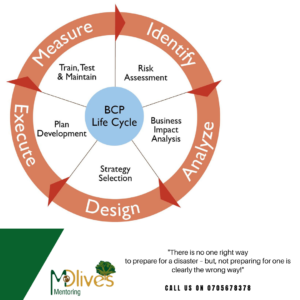
Business Continuity Planning (BCP)

[vc_row][vc_column][vc_column_text]You possibly know about Business Continuity Planning (BCP) and that it helps a business continue operating in the event of major disasters e.g. fires. However, and possibly like me, less did you know that a disaster can get this close and hit this hard leaving your Businesses on its knees-that is what COVID-19 has done. It is, therefore, now time to not only think about BCP but to get it done as soon as possible.

And so we get to ask ourselves; What is Business Continuity Planning (BCP)? Why do you need it? And how do you do it?

What is Business Continuity Planning (BCP)? ; It is the process a company undergoes to create prevention and a recovery system from potential threats such as natural disasters (fire, floods) or cyber-attacks, relevant example being the current COVID-19 crisis.

Longevity in business is about being able to reinvent yourself: Satya Nadella

Why Business Continuity Planning (BCP)? ; Becoming an entrepreneur is all about taking risks. In order to ensure that your business is sustainable, you need to put in place systems that can prevent threats whether internal or external that may try to interfere with your day to day operations. BCP ensures that personnel and assets are protected and are able to function quickly in the event of a disaster. Some benefits of BCP include;

  • It enables your business to be well prepared for a disaster
  • It gives your business more flexibility so that it can adapt to changes in future
  • It stops the staff from panicking in case the business is faced with a threat
  • It helps to minimize losses

During the COVID-19 crisis BCP will help you to; 1) Establish the risk profile of your business and the level of vulnerability to COVID-19 in terms of its impact on your People, Processes, Profits and Partnerships (the “4Ps”).

  • People: lives of workers and family members
  • Processes: enterprise operations
  • Profits: revenue generation
  • Partnerships: enabling environment to carry out business operations

and 2) Develop an effective risk and emergency arrangement for the business.

“It takes years to build a Business but only minutes to lose it” Warren Buffet

How do you write a Business Continuity Plan during this COVID-19 crisis? BCP is generally conceived in advance and involves input from key stakeholders and personnel. It is important to consider using a Business Continuity Planning (BCP) tool. Let us look at a tool that is mostly targeted at smaller enterprises with limited resources and structured in two parts.

  • The first part of the tool is risk assessment that you can quickly do. It establishes the level of risk/vulnerability to your enterprises.
  • The second part of the tool is six-step processes to assist you develop your own Business Continuity Plan.

Part 1: Establish your risk profile (Self-assessment); Here you need to ask yourself questions around the 4P’s; ‘People, Processes, Profits and Partnerships’. You will then need to estimate your vulnerability level by use of a Risk Matrix which will help you do a comprehensive assessment and hence identify which of the 4P’s (people, processes, profits and partnerships) your business is most vulnerable to (and which aspects in particular).

Part 2: Develop a six-step COVID-19 BCP; The following are the six steps needed to establish your business continuity plan (BCP):

Step 1: Identify your key products/services.  What are your most important products/services? Consider the following criteria:

  • Share of income they generate
  • Amount of clients demanding them; and
  • Cost of non-delivery (what happens if you don’t deliver): negative financial, productivity and reputational consequences.

Step 2: Establish the objective of your BCP. What do you want to achieve by establishing your BCP?

Consider the following; What departments will the plan cover? What are the outcomes of a successful plan? Which milestones should we track?

Step 3: Evaluate the potential impact of disruptions to your business and workers/staff. How long can interruptions last before becoming intolerable? What are the resources required and who are the suppliers/partners/ contractors needed to conduct key operations?

Step 4: List action to protect your business by using the 4Ps framework.  Consider actions to minimize risk to your: People(lives of workers and family members), Processes(enterprise operations), Profits(revenue generation) and Partnerships(enabling environment to carry out business operations).

Step 5: Establish contact lists. Note that most of your activities will be non-physical (Mobile phone calls, texts, WhatsApp calls, zoom meetings, Googlemeet etc).  Make sure you have accurate and updated lists of all your key stakeholders (suppliers/partners/ contractors).

Step 6: Maintain, review and continuously update your BCP; Once you have a business continuity plan in place, don’t forget to update and adapt it regularly. A BCP that is not constantly tested and updated will be of little help. Changes have to be monitored; impacts, risk and continuity strategies need to be reevaluated.

“The only thing harder than planning for a disaster is explaining why you didn’t”

“You never want a serious crisis to go to waste” Obama Chief of staff

 [/vc_column_text][/vc_column][/vc_row][vc_row][vc_column width=”1/2″][vc_single_image image=”620″ label=””][vc_column_text]Mary Kamore is the Lead Consultant MoliveS Mentors[/vc_column_text][/vc_column][/vc_row]
Share this cohort:
Women-Mentoring-2-Copy

Mother’s day 2020-Celebrating Mama Entrepreneur

[vc_row][vc_column][vc_column_text]The COVID-19 crisis is predicted to have far-reaching consequences that will be felt for years to come. We have started witnessing its grave impact on the global economy, particularly, on business entrepreneurship.
As we celebrate all Mothers this week, It is important to note that the impact of the COVID-19 pandemic is not gender neutral, as it affects men and women differently. Globally, women are more vulnerable to economic shocks wrought by crises such as the corona-virus pandemic.

Why are women at risk?  Firstly, women are more likely to lose their jobs than men. In many countries, women’s participation in the labour market is often in the form of temporary employment. Secondly considering that most women rely on small businesses for their livelihoods, due to Covid-19 majority are extremely stressed; low sales, reduced or closed markets, limited mobility, no income alternatives, and no safety nets. Most importantly women have to balance between being a mother (mama) and career/Business.

Balancing Family and work

With families at home; children not going to school and both men and women working from home you will still find more women jumping into household chores than men. Sometimes the so called ‘online learning’ for your children is not ‘online learning’ until it is combined with ‘mama learning’ But as a ‘mama’ entrepreneur you cannot afford to lose the opportunity to meet the sharp increase in demand that has just come your way during this Covid-19. Furthermore you just cut your salary by half and have asked your staff to work part-time as you expect tough times ahead. Hard as it may be for you, keep it there and do whatever it takes to balance both family and work. They both desperately need. Never doubt your strength to give each sufficient attention.

Going digital

Did you know that you can retain a bulk of your clientele without necessarily having to be there physically? It is now the time to focus heavily on providing more of digital marketing services and this allows you to work remotely. The biggest lesson here is to invest just a little in a digital skill set.

As a ‘Mama Entrepreneur’ you can chose to block out the first half of your day (or more/less) managing/running your Business remotely and the second half of your day as time for meditation, reading, and bonding with loved ones. And there you go; Family and work done. “be sure to use this time wisely. Learn something new, sharpen your skills and be grateful for the life you have.” Happy Mother’s day!

Help another

“Virtue cannot live in isolation: Neighbors are sure to grow around it”. Regardless of your situation, remember you have something to offer as well—a connection, an insight, a skill, an encouragement etc. You will find women around you who believe there is no hope or solution in this current crisis. Be there to give them hope. What about educating that ‘mama’ on how she can build a new stream of income? What about encouraging her to pass the knowledge already gained to others within her reach?  There is enough success to go around and if everyone goes out of their way to help one another, we can truly improve each other’s quality of life. So reach out to someone and offer to help, it doesn’t have to cost you money and you know what? Help has a way of coming back to you!

Self-care

As a ‘Mama Entrepreneur’ trying to do it all can be a recipe so know your limits and enforce them. Self-care is not selfish. Repeat-Self-care is not selfish! You need you strong and healthy to be of service to all those looking up to you and hence the need to be fueled for the long haul. Apply these few tips;

  • Make sleep a non-negotiable; Give yourself the best gift you can during this stressful time and get enough sleep
  • Shower and get dressed every single day; Showering and getting dressed (preferably into NON-pajama clothing) communicates to your brain and subconscious that it’s time to get to work.
  • Write a task list for each day and stick to it; Either at the end of your workday or first thing in the morning, compose a list of all your tasks for the day.
  • Talk to at least one human every day; It’s no news that human beings need connection. We literally can’t survive without it. You don’t need a specific reason for talking/calling someone – simply connecting is all the reason you need.
  • Dust off ideas from your “Someday Maybe” list; Guess what? Now that you’re at home for who knows how long, it’s the perfect time to dust off those “someday maybe” items and turn some of them into “this week for sure” items.
  • Watch something every day that makes you laugh; Laughter is good for the body and good for the soul. And I think we all need a lot more of it these days, wouldn’t you agree? Treat yourself to something every day that will make you laugh. Your body will thank you!
  • Devise your own personal mantra for getting through this; When you say something over and over again relentlessly in your mind, your brain begins to support that thought or belief. What will you train your brain to believe during this crisis? Possibly something like: “I will come out of this stronger and wiser than ever.”

“Self-care is not a waste of time. Self-care makes your use of time more sustainable.”– Jackie Viramontez[/vc_column_text][/vc_column][/vc_row][vc_row][vc_column width=”1/2″][vc_single_image image=”835″ label=””][vc_column_text]Mary Kamore is the Lead Consultant, Molives Mentors[/vc_column_text][/vc_column][vc_column width=”1/2″][/vc_column][/vc_row]

Share this cohort:

Business Model Canvas

[vc_row][vc_column][vc_column_text]

What and Why a Business Model Canvas?

A ‘Business model’ is a description of how your business makes money-it describes how a Business creates, delivers and captures value.

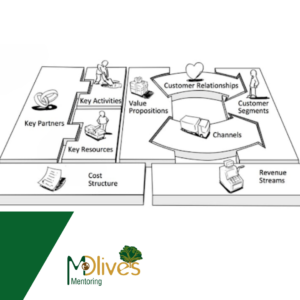
A Business Model Canvas is a great way of mapping out an idea, allowing it to be understood, tested and improved. The tool is a single page with nine connected boxes, which show how all parts of your business work together for success. It can be sketched anywhere – on a whiteboard or notepad. A Business Model Canvas can be used when starting a new Business or when updating an existing Business idea

When filling out a Business Model Canvas, it is important to brainstorm and conduct research on each of the nine elements.  This week we discussed four of the elements.

  1. Customer Segments

In this building block, you enter the different customer segments that you will serve. These are the groups of people or companies that you are trying to target and sell your product or service to.

Segmenting your customers based on similarities such as geographical area, gender, age, behaviors, interests, etc. gives you the opportunity to better serve their needs, specifically by customizing the solution you are providing them. One really important point to get across here is that customers don’t exist for you, but rather you exist to serve your customers.

Question; Which customers and users are you serving? Which jobs do they really want to get done?

2. Value propositions

At the center of your Canvas is the Value Proposition box. Inside this very important box you write down your unique solution (product or service) for a problem faced by a customer (that which creates value for the customer segment). A value proposition should be unique or should be different from that of your competitors.

Think about a ‘Unique Value Proposition’ (UVP)-why are you different and worth getting attention? What are you offering them? Some common value propositions are include; High performance, Ability to customize, Design, Price, Convenience etc.

Good news! You don’t have to get this perfect right away. Like everything on the Canvas, start with a best guess and perfect as you go.

  1. Channels

In this block you describe how your company will communicate with and reach out to your customers. How does each customer want to be reached? How are your products and services delivered to the market?

Channels are the touchpoints that let your customers connect with your company. They play two main roles; (i) raising awareness of your product or service among customers and (ii) delivering your value propositions to them.  There are two types of channels

  • Owned channels: This includes your company/business website, social media sites, in-house sales, etc.
  • Partner channels: These are partner-owned websites, wholesale distribution, retail etc

4. Customer Relationships

In this section, you write down the type of relationship you will have with each of your customer segments.  How will you interact with them throughout their journey with your business?  It is here that you answer the question of how you get, keep, and grow customers;

  • Get: Establish how customers find out about you to make their initial purchase e.g. advertising on Google/facebook, referral etc.
  • Keep: How do you keep customers? e.g. excellent customer service.
  • Grow: How do you get your customers to spend more? e.g sending out a monthly update/newsletter to keep them informed about your latest products or service.

The easiest way to define all of this is to walk through the entire customer journey in detail- a customer journey map. Know how customers find out about you, investigate whether to buy your product, purchase it and how they are managed after purchase.  This will help you make sense of how to get, keep and grow your customers.[/vc_column_text][/vc_column][/vc_row][vc_row][vc_column width=”1/2″][vc_single_image image=”835″][vc_column_text]Mary Kamore is the Lead Consultant M_OliveS Mentors[/vc_column_text][vc_column_text][/vc_column_text][/vc_column][vc_column width=”1/2″][/vc_column][/vc_row][vc_row][vc_column][/vc_column][/vc_row]

Share this cohort: